
Criminal Cases in the Schoharie County Courts
Schoharie County Court and New York Supreme Court handle superior-court criminal matters. In New York, Supreme Court is a trial court despite its name. The Schoharie County Clerk serves as clerk of both courts and keeps their filed criminal records. Those records may include an indictment or superior court information, motion papers, calendar entries, a plea or verdict, the judgment, and the sentence.
Local criminal courts have a different role. The county has 16 town courts, while village justice courts operate where established. They may handle misdemeanors, violations, vehicle and traffic matters, warrants, arraignments, and the first steps in a felony. Their clerks retain those local dockets. A felony can start under one local docket number and later gain a new County or Supreme Court identifier after grand-jury action or a waiver of indictment. The official Schoharie County directory and the Third Judicial District court directory identify the right local clerk.
Schoharie Court Cases Change Clerks
A single prosecution may produce records in two places. A town or village justice court can conduct the arraignment and preliminary felony work. If the grand jury returns an indictment, or the accused waives indictment and proceeds by superior court information, later case records move through Schoharie County Court or Supreme Court. The first docket does not become a County Clerk file merely because the incident occurred within Schoharie County.
Start with the court named on the newest notice or WebCrims entry. Ask that clerk whether the matter remains local or has a superior-court number. This step prevents a common dead end: calling the County Clerk for a misdemeanor file that never left a town court, or calling the arraignment court for a felony judgment filed later in County Court.
Note: A local arraignment docket and a superior-court docket may describe the same event under different case numbers.
How to Search Case Records
New York WebCrims is the first online channel for available public defendant, case, calendar, and appearance details. It is useful for locating a pending Schoharie County court case and checking the listed court, status, charge, or next date. It is not a full document repository. Sealed and youthful-offender matters are excluded, and older or unindexed files may require direct clerk contact.
- Open WebCrims and choose the defendant, case, or court-calendar search that fits the known facts.
- Enter the name carefully, or use the exact case, SCI, or indictment number when one is known.
- Select Schoharie County or narrow a common name with the date of birth where the portal permits it.
- Read the court name, case status, charge, and appearance data, then confirm any new date with the clerk.
- Request the filed instrument, judgment, disposition, or certified copy from the court shown on the result.
| Field Label | Type | Required | Notes |
|---|---|---|---|
| Defendant Name | Text | Search-dependent | Spelling matters |
| Date of Birth | Date/text | Optional | Helps narrow common names |
| County | Dropdown | Optional | Select Schoharie or All Counties |
| Case/SCI/Indictment Number | Text | Alternate key | Use the exact court identifier |
| Court Date | Date | Optional | Used for the calendar search path |
Schoharie Court Records at Main Street
WebCrims can point to a case, but the filed record comes from its clerk. For Supreme and County Court matters, contact the Schoharie County Clerk at 284 Main Street, first floor, Schoharie, NY 12157, or call 518-295-8316. The counter is open weekdays from 8:30 a.m. to 5 p.m., with daily filing and recording ending at 4:30 p.m. Older, document-level, or unindexed criminal case records may need a telephone, mail, or counter request.
State which paper is needed. A certified disposition answers a different question from a full docket or charging instrument. The inspected county page did not publish a criminal-copy or certification fee schedule. Ask the clerk for the current charge before ordering. The clerk also warns that credit cards cannot be accepted until further notice; cash, check, and money order are accepted.
Supreme and County Court Clerk
284 Main Street, first floor
Schoharie, NY 12157
518-295-8316
Weekdays, 8:30 a.m. to 5 p.m.
What the Case File Shows
A Schoharie County court file is case-centered, not a list of every event tied to a person. It tracks the court, parties, filed accusations, charge changes, hearings, motions, plea or trial result, judgment, and sentence for one prosecution. That makes the filed case record the best source for determining what charge the court actually resolved. A jail booking record may still show only the allegations received at admission.
| Case Number & Court | The docket identifier, court, county, and case status. |
|---|---|
| Charging Document | The complaint, information, indictment, or superior court information that invokes jurisdiction. |
| Docket Entries | Filed events, motion activity, counsel information, and court actions. |
| Hearing Dates | Past or scheduled appearances, time, part, and purpose where available. |
| Disposition & Judgment | The pending status, dismissal, acquittal, guilty plea, or verdict and resulting judgment. |
| Sentence & Conditions | The court-ordered consequence, including custody, probation, restitution, or other terms where filed. |
WebCrims may display the court, case identifier, charge, status, calendar data, and disposition. It may also flag a warrant condition that affects reporting. It does not provide every filed document for free. Obtain the signed judgment or certified disposition from the clerk when exact proof of outcome matters.
Schoharie Case Records After Charging
The arresting agency and jail do not decide the final filed charge. The Schoharie County District Attorney prosecutes crimes and offenses in County and Supreme Court as well as town and village courts. Charges can be amended, dismissed, replaced by an indictment, or resolved through a plea. The court docket and signed disposition show those later acts.
The official District Attorney page depicts the county office responsible for prosecutions. The image below comes from that county source.
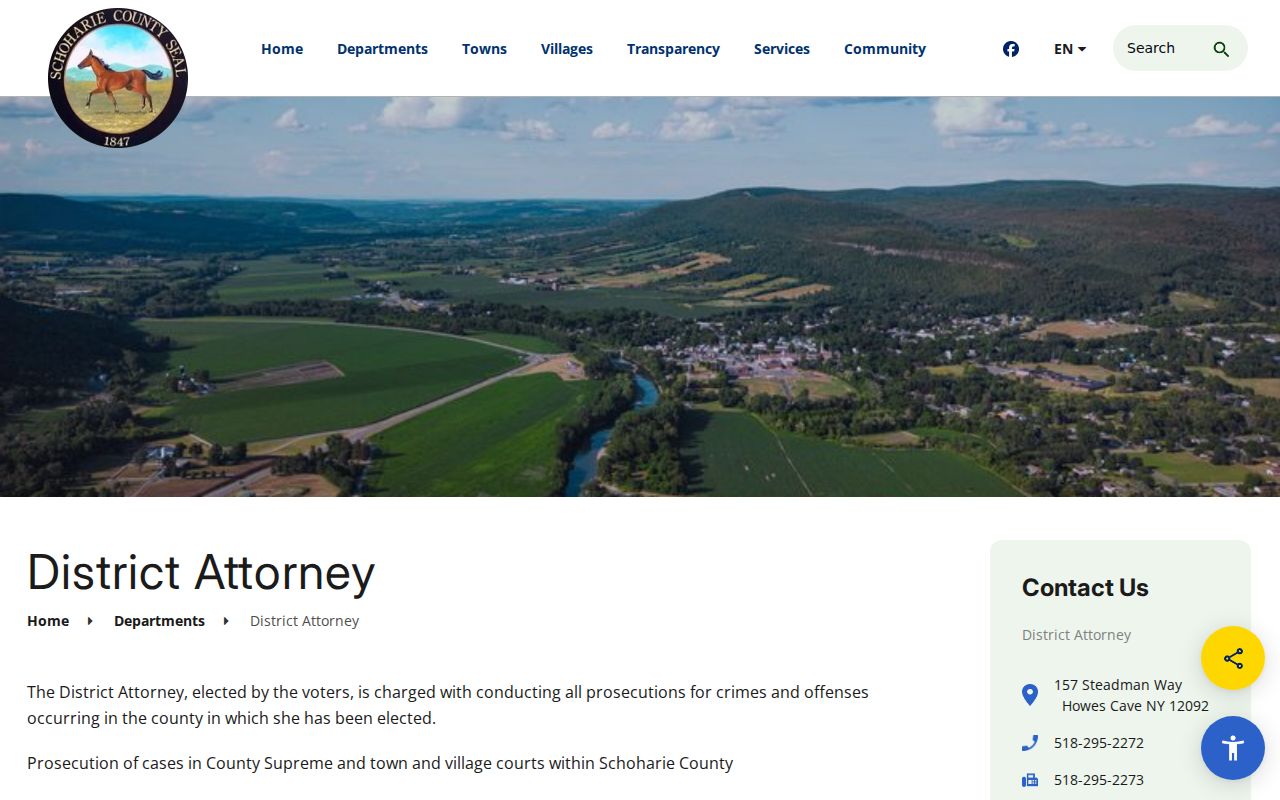
That office works from the Howes Cave public-safety hub, while the superior-court case file remains with the clerk in Schoharie. The split is why a reader may need the court record even after learning which prosecutor handled the matter.
Stages of a Criminal Case
The clerk's entries make more sense when read as a sequence. A prosecutor files or pursues charges, the court conducts an arraignment, and pretrial work follows. The matter may end through dismissal, plea, or trial. A conviction then leads to judgment and sentencing. Felony cases can also include grand-jury action or waiver of indictment before the superior-court phase.
Case flow: Charges Filed › Arraignment › Pretrial › Plea or Trial › Disposition › Sentencing
An arraignment is the first appearance at which the court addresses the charge and rights and takes a plea where appropriate. A disposition is the outcome of a charge or case. The sentence is the consequence ordered after conviction. Each term marks a distinct point, so a pending charge should not be read as a conviction or final judgment.
Schoharie Case Records and Assigned Counsel
Schoharie County uses an Assigned Counsel Program rather than a conventional county public-defender staff. A person charged with an offense that can result in jail and who cannot afford counsel may apply. Criminal applications may be mailed, emailed, or placed in the drop box at 284 Main Street. The program can be reached at 518-295-8740 on weekdays from 9 a.m. to 5 p.m.
Counsel assignment does not replace the court docket. The relevant court clerk still holds the filed case record, hearing entries, disposition, and judgment. A person seeking help with the defense should contact the program, while a person seeking a public or certified case document should contact the court that holds the case.
Schoharie Court Records Beyond WebCrims
The Office of Court Administration's Criminal History Record Search, or CHRS, is another court-data channel. It costs $95 per search and uses an exact name and date of birth. It reports qualifying public open or pending cases and convictions from courts across New York. It is not fingerprint-based, and name variants need separate searches. A mail request is available, while the CHRS unit does not offer in-person service.
CHRS and a certified disposition serve different aims. CHRS searches statewide public court data for an exact identity entry. A certified disposition comes from the court file and proves the outcome of a known case. Under OCA policy, a matter with no final disposition and no activity in the past five years is omitted unless an open arrest warrant remains. A missing CHRS result therefore does not prove that no old or sealed Schoharie County court record exists.
Federal criminal cases use a separate system. The official PACER source shown below is the federal docket and document access portal, not a Schoharie County court database.
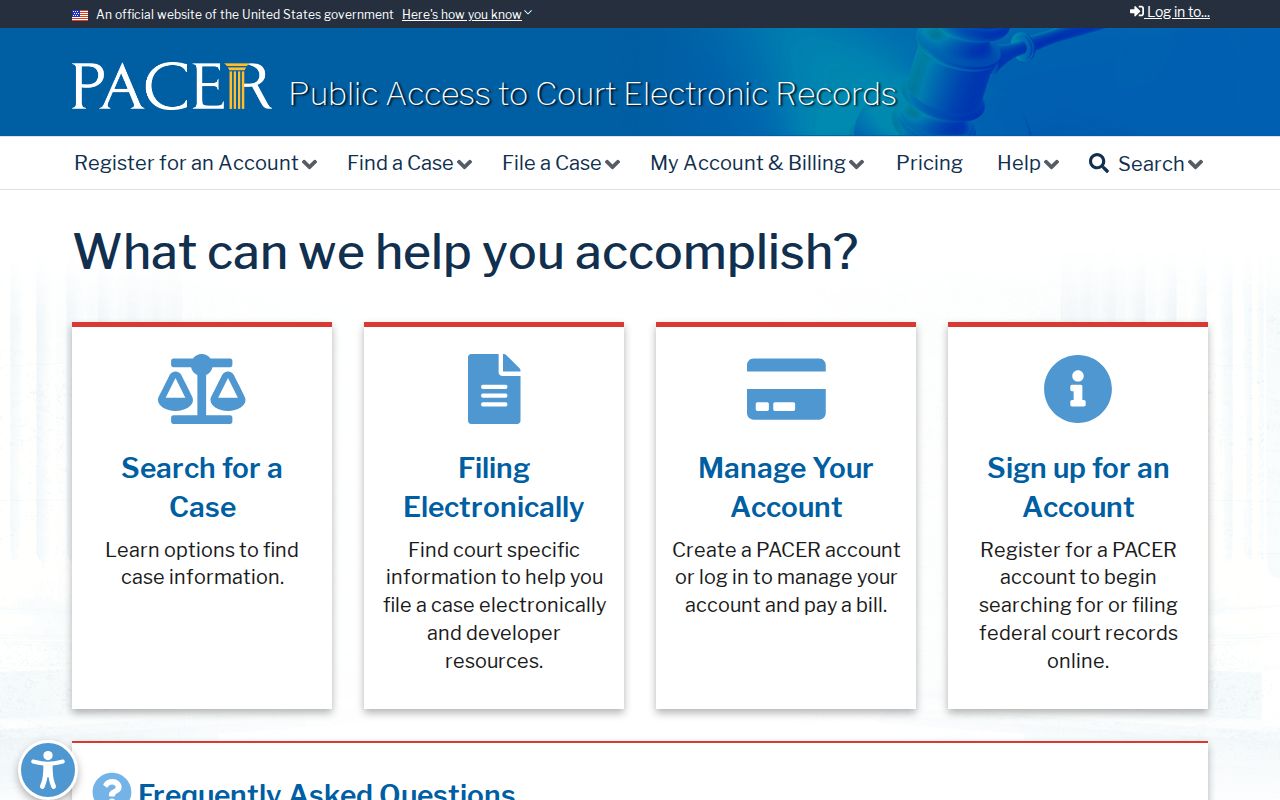
The portal image reinforces the jurisdiction split: New York court cases belong in WebCrims, CHRS, or the filing court, while federal dockets are searched through PACER.
Access & Restrictions
New York trial-court clerks provide public court records under Judiciary Law section 255 and court-access rules, subject to sealing and other confidentiality laws. Court files are not simply executive-agency records obtained through the New York Freedom of Information Law. Send a request for a filed Schoharie County criminal case to the clerk that keeps it, not to the Sheriff or a general county records officer.
Sealed cases, youthful-offender matters, and other confidential records do not appear through ordinary public searches. Favorable-termination sealing under Criminal Procedure Law section 160.50 can remove qualifying records from normal view. Redactions may also protect victim details or other information barred from disclosure. Executive Law section 837(8) separately limits dissemination of DCJS criminal-history records, so another person's DCJS rap sheet cannot be obtained through FOIL.
For a public file, give the court a docket number, party name, and approximate year when known. Request the exact item needed, such as the accusatory instrument, docket, judgment, or certified disposition. That approach is faster and more precise than asking the office for a broad criminal-history report.