
Running a Sex Offender Check in Schoharie County
The main public web channel is the New York State Sex Offender Registry Subdirectory, which the Division of Criminal Justice Services, or DCJS, administers under the Sex Offender Registration Act. Choose Schoharie in the county field to see public entries tied to the county. A last-name or ZIP search can narrow a different question. The web directory is free, but its scope is limited. It publishes qualifying Level 2 and Level 3 registrants, not every person registered in New York.
Use the DCJS phone line for a Level 1 registrant or a person whose risk level has not been set. Use the local police agency to ask about registration procedure or suspected noncompliance. The Schoharie County Sheriff's Office covers county areas, while Cobleskill Police handles its village jurisdiction. NSOPW is the right added search when an address or move crosses state lines. These channels answer different parts of a Schoharie County sex offender check, so one blank result should not end the inquiry.
Prepare the smallest useful set of facts before starting. A countywide safety review needs only the Schoharie selection. A known person inquiry calls for a verified spelling, and the state telephone process requires one more identifier. Keep the date of the search because profiles can change after an address check, custody event, or new photograph. The aim is an accurate reading of the current official disclosure, not a collection of facts from unrelated sources.
Schoharie Level 1 Registry Calls
Level 1 means a court found a low risk of reoffense. It does not mean the registration vanished. New York keeps Level 1 entries out of the public online Subdirectory. For a Schoharie County registry verification, call DCJS at 800-262-3257, choose option 2, and call on a weekday from 8 a.m. to 4 p.m., excluding legal holidays. Be ready with the person's name and one added identifier: an exact address, date of birth, driver's-license number, or Social Security number.
The same phone route applies when a risk level is not yet determined. That detail matters because the public web directory is not a complete list of all people subject to registration. A caller should use only identifiers lawfully available to them and should not guess at sensitive numbers. If the state operator cannot verify the person from the supplied facts, the correct next step is to check the spelling and address, not to treat the call as proof that no registration exists.
The phone response and the web result answer different legal questions. The online search asks whether DCJS may publicly display a matching Level 2 or Level 3 record. The call can verify a matching Level 1 or undetermined-level registration when the caller supplies the required facts. Neither channel promises real-time knowledge of where a person is at that instant. Registration data follows the reporting and verification events set by New York law.
Note: The DCJS telephone channel fills a legal visibility gap; it is not a duplicate of the Schoharie County web search.
Searching the New York State Sex Offender Registry
The DCJS directory search is short, but its choices are easy to misread. The form says to choose one primary field. For a countywide view, select Schoharie rather than combining it with a surname or ZIP. Read and accept the linked disclaimer, complete the CAPTCHA, and then submit the search. The result set represents the directory's public Level 2 and Level 3 scope at that moment.
- Open the DCJS public Subdirectory and read the conditions and disclaimer before searching.
- Choose one primary search field: last name, Schoharie County, or a five-digit ZIP code.
- Use custody exclusion boxes only when that category is outside the purpose of the search, then complete the CAPTCHA.
- Open a possible match and compare the full profile, photographs, aliases, offense facts, status, and update information.
| Field Label | Type | Required | Notes |
|---|---|---|---|
| Last Name | Text | One of three | Search by surname |
| County | Dropdown | One of three | Select Schoharie from all New York counties |
| Zip Code | Text | One of three | Enter a five-digit ZIP |
| Custody exclusions | Checkboxes | Optional | Exclude incarcerated, ICE custody, or other custody entries |
| CAPTCHA | Checkbox | Yes | Complete before using Search |
The official search form shown here illustrates the county, surname, and ZIP choices used for a Schoharie County registry search.
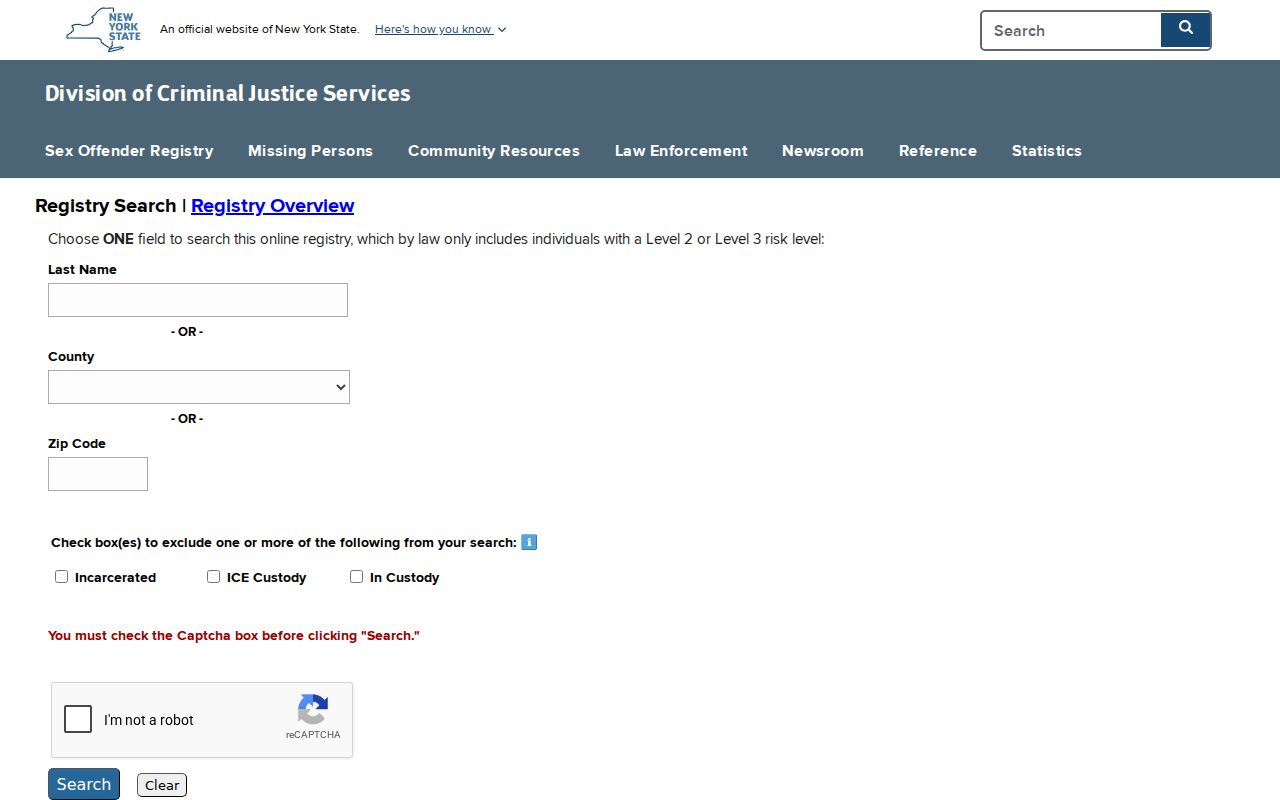
Its narrow field set confirms that the service is a directory, not a street-radius map or a search by age, offense, vehicle, or risk level.
Open the result rather than relying on the short list view. Similar names can refer to different people, and photographs may include more than one point in time. The profile's jurisdiction, offense, physical description, and address details provide the context needed to assess a possible match. If those facts conflict, do not merge the records. Return to the result list or ask DCJS about the proper verification channel.
Schoharie Registry Fields Choose One
A common search error is to expect a map with a radius around a home, school, or park. The New York form inspected for this project provides no city, street-radius, map-radius, age, sex, offense, vehicle, or tier filter. It asks for one of three primary values. Select Schoharie County to review the public county set. Use a surname when the identity is known. Use a ZIP when the concern is tied to that postal area.
The optional custody boxes can remove people shown as incarcerated, in ICE custody, or in another custody category. Excluding those records may make a list easier to read, but it also narrows what the list reveals. Clear the form before changing the core search method. If a result is absent, try a relevant primary field by itself and then use the phone channel. That method respects what the state form can and cannot establish.
A county and a ZIP are not interchangeable. Schoharie County contains more than one postal area, and a ZIP can cross the boundaries a reader has in mind. The county filter answers the broader county question as DCJS codes it. The ZIP field answers only the supplied postal code. The surname field is strongest when the name is known but does not remove the need to compare the profile. Pick the field that matches the actual question.
Note: Clear the form before switching methods so an old Schoharie County field does not narrow the next registry query.
What a Registry Profile Shows
A public profile brings identity, risk, offense, and status facts into one registry disclosure. Read the whole record before deciding whether it matches the person in question. A current or past photograph and an alias can prevent a false match. Address and custody fields can change between verification events. The profile is not live surveillance, and it does not replace confirmation by the agency responsible for the registration.
| Name & Aliases | Legal name and any aliases that the public record supplies |
|---|---|
| Photo & Physical Description | Current and historical photographs, plus identifying physical traits |
| Registered Address | Home or work address information when New York law authorizes public display |
| Offense & Statute | Registerable conviction, jurisdiction, statute, description, and dates when supplied |
| Risk Level | Level 2 or Level 3 on public web profiles, plus special designations where applicable |
| Registration Status | Supervision, custody, registration, compliance, update, and jurisdiction details when supplied |
Some profiles may also expose vehicle, school, scars, marks, tattoos, or other fields when the statutory public record permits them. Absence of one field is not permission to infer it. Compare only what DCJS actually publishes, and report an apparent address problem to law enforcement rather than trying to investigate it in person.
The offense section describes the registerable conviction, not every arrest or court allegation linked to a person. Dates can refer to the offense, conviction, registration, or a later update, so read each label closely. Risk level is a judicial finding about reoffense risk for notification purposes. Custody and supervision fields, when supplied, describe status at the time reported. None of those labels turns the registry profile into a full Schoharie County criminal case file.
NSOPW Beyond Schoharie Registry Results
A Schoharie County search can miss a person whose registration is held by another state, territory, tribe, or the District of Columbia. The U.S. Department of Justice's National Sex Offender Public Website, known as NSOPW, searches participating public registries through one national layer. Use it when a move, former address, or nearby state makes the New York-only directory too narrow.
The official NSOPW interface pictured here provides geographic and name-search routes beyond Schoharie County.
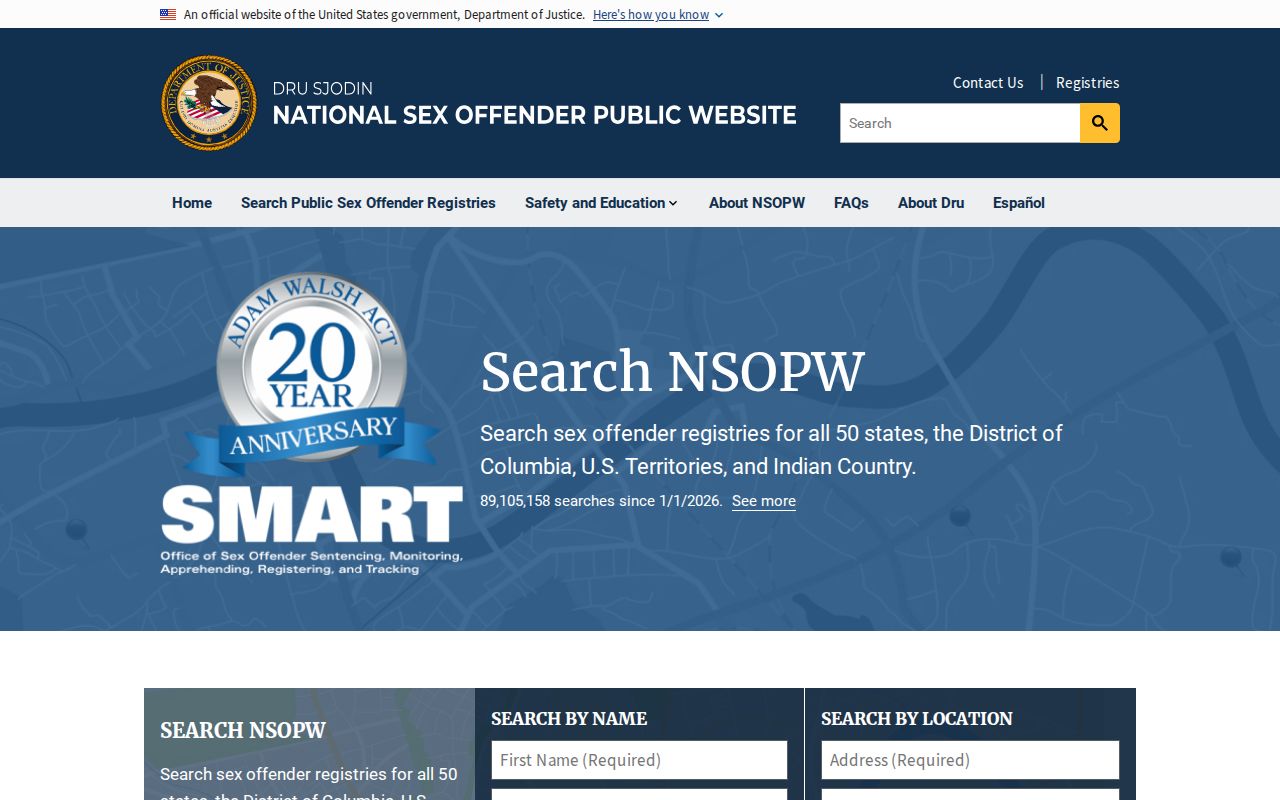
A national match is a lead, not the final source. Open the linked originating registry and verify its current profile, scope, and update terms. New York's own phone line remains necessary for a New York Level 1 or undetermined-level inquiry because public systems do not turn nonpublic state entries into national web results.
Start with name searching when the identity is known. Use a geographic option when the location is the main fact, then read the participating jurisdiction's rules. Public scope differs by jurisdiction, which means two source registries can show different kinds of details without either result being a complete criminal history. When NSOPW routes back to New York, use the DCJS record as the source for level, designation, address disclosure, and update information.
Registration Requirements and Levels in New York
A judge assigns the New York risk level after a hearing. Level 1 reflects low risk, Level 2 moderate risk, and Level 3 high risk. These state risk findings are not the same as federal SORNA tier labels. Special designations such as sexual predator, sexually violent offender, or predicate sex offender can also change the registration term. Check the person's offense, designation, and effective-law history against Correction Law Article 6-C, especially section 168-h, rather than relying on a headline duration alone.
| New York Level | General Duration | Verification and Visibility |
|---|---|---|
| Level 1, low risk | Generally 20 years unless a lifetime rule or designation applies | Annual address verification; photo every three years; not displayed in the public web Subdirectory |
| Level 2, moderate risk | Generally life | Annual address verification; photo every three years; public online |
| Level 3, high risk | Generally life | Personal address verification every 90 days; annual photo; public online |
Level 3 registrants and those designated sexual predators must personally verify their addresses every 90 days with the police agency having jurisdiction. Photo timing also varies. Level 1 and Level 2 registrants submit a new photograph every three years, while Level 3 registrants submit one each year. Police may take a new photo after a major change in appearance. These cycles explain why a profile photo and an address verification date may not match. New York's inspected state overview did not state a general statewide school or park distance ban, so any claimed local limit needs a valid, current enactment.
The DCJS SORA legal overview shown here explains the law and the limits of public registry access.
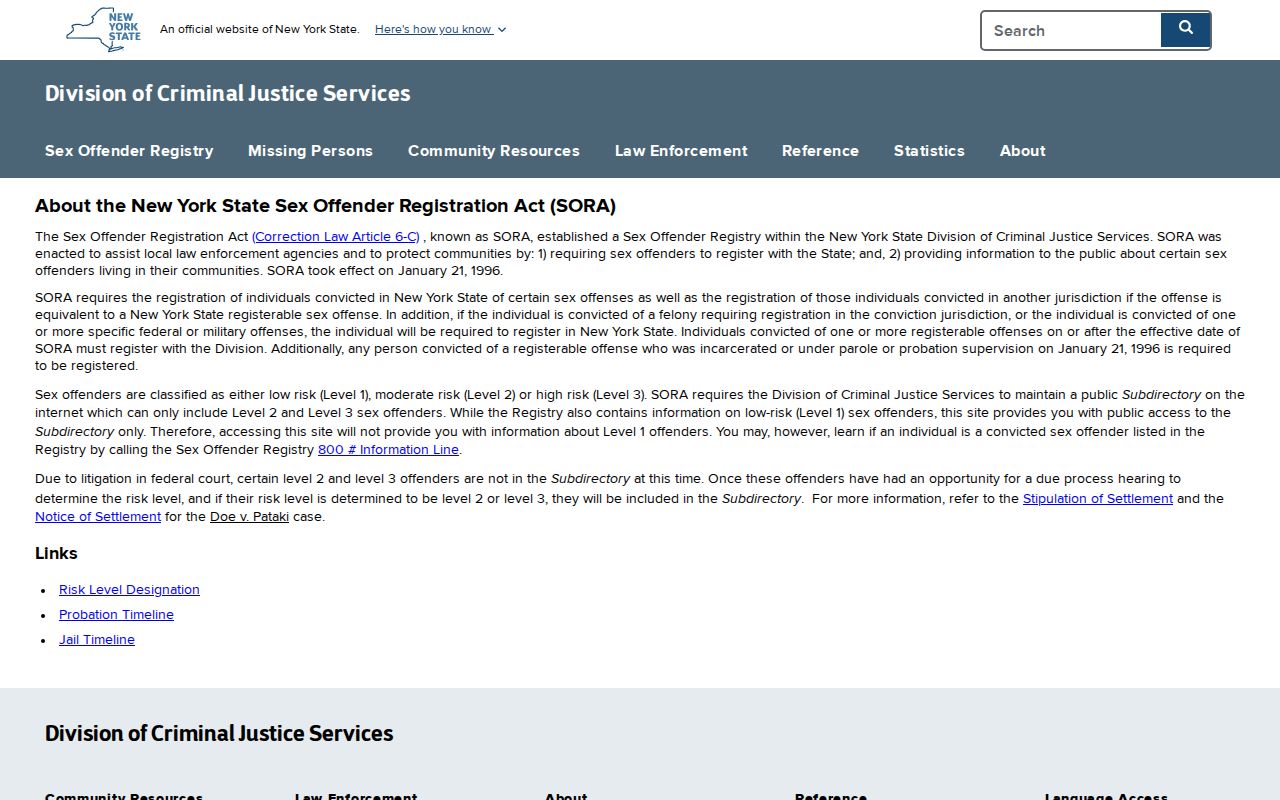
That state source is the sound place to confirm why web visibility, registration length, and verification duties do not line up in one simple rule.
Note: New York risk level controls public notice and verification duties, while special designations can change a Schoharie registration term.
Schoharie Registry Jurisdiction Routes
Local registration and address verification follow police jurisdiction. For county areas, begin with the Schoharie County Sheriff's Office at the Harvey E. Stoddard Public Safety Facility, 157 Steadman Way, Howes Cave, New York 12092. For an address within the Village of Cobleskill, contact the Cobleskill Police Department. The county's official municipal directory helps identify the proper local office when the village, town, or postal address is unclear.
Ask the agency to confirm its procedure before sending personal facts or appearing at a counter. A registration question is not the same as a Freedom of Information Law request. If the concern is a false address or a missed verification, report the facts to the agency with jurisdiction. Do not confront the person or household. Police can compare the report with nonpublic compliance information and decide whether further action is warranted.
Postal wording can cause a local handoff error. An address that says Cobleskill does not by itself prove that the Village Police have jurisdiction, just as a county address does not always show the responding agency. Give the exact location when asking where to report. The official county directory and the agencies themselves can route the question. This is safer and more precise than choosing an office from the mailing city alone.
Schoharie County Sheriff's Office
Harvey E. Stoddard Public Safety Facility
157 Steadman Way
Howes Cave, NY 12092
Confirm the proper registration contact through the official Sheriff page before visiting.
Cobleskill Police Department
Village jurisdiction
518-234-2923
Call for the current village registration and reporting procedure.
Schoharie Registry No-Result Limits
A blank Schoharie County result has several possible meanings. The person may be Level 1, may have no final risk level, may be registered in another jurisdiction, or may not match the exact field used. DCJS also warns that litigation can temporarily keep some Level 2 or Level 3 cases out of the directory while due-process risk-level hearings remain pending. The result only states what the public directory returned for that query.
Check the spelling and try the most fitting single field. Call DCJS when Level 1 or a pending level is relevant. Search NSOPW when another state may hold the entry. Contact the Sheriff or Cobleskill Police when the issue is local compliance. This fallback chain is more accurate than widening the claim made by one database response.
Keep each negative result tied to the method that produced it. “No match by this surname” is narrower than “no one is registered.” The same is true of a single ZIP. If the purpose is county awareness, run the Schoharie field without unnecessary custody exclusions. If the purpose is identity verification, use the known name and the state phone requirements. A precise note of the query and date makes later follow-up more useful.
Note: No-result follow-up protects both community safety and accuracy by separating an incomplete public search from a verified state response.
Lawful Use and Community Notification
Registry information supports personal safety, family planning, and informed community awareness. New York notification varies with risk level and the recipients whom the law authorizes to receive information. Public display is one part of that system. Local police verification and the DCJS phone channel remain distinct. Use the data to make calm safety choices and to give a clear report to law enforcement when facts suggest noncompliance.
The search disclaimer is part of the lawful-use rules. It bars using registry information to commit a crime or to intimidate, harass, or threaten. New York can apply otherwise relevant Penal Law provisions and civil law to harmful conduct. Correction Law Article 6-C authorizes disclosure for public safety; it does not authorize vigilantism or direct enforcement by a member of the public.
Use registry data lawfully: Correction Law Article 6-C governs New York registry disclosure. Using that information to commit a crime, threaten, intimidate, or harass may bring consequences under applicable Penal Law and civil law. Report suspected noncompliance to law enforcement and do not confront anyone.
If a profile seems stale, note the exact field, date viewed, and source URL before calling the local agency. A concise factual report gives the Sheriff or Cobleskill Police something they can check. Avoid publishing an accusation based only on an old address, a similar name, or a search result from a different state.